The short version. Patient scheduling is how a clinic books, confirms, changes, and refills appointments. Two things break it: patients who can't get through on the phone, and booked slots that go unused. This guide covers what causes no-shows and long hold times, how to measure both, and 8 practical fixes, each with an action and an example.
It is 8:02 on a Monday morning. A patient calls to move her Tuesday appointment. She waits on hold, hears the same message three times, and hangs up to get to work. On Tuesday at 10 a.m., her slot sits empty. Nobody knew it would be free, so nobody else got it.
That one moment holds both problems this guide answers: patients who can't get through on the phone, and booked slots that go unused. The questions below cover what patient scheduling is, why it breaks, and 8 practical ways to cut no-shows and hold time, each with an action and an example.
What is patient scheduling?
Patient scheduling is the process a clinic uses to book, confirm, change, and fill appointments. It covers every step from the first call or online request to the moment the patient checks in. People also call it medical scheduling or patient appointment scheduling.
A working scheduling process does four jobs:
- Books the right visit type in the right slot length (a new patient visit needs more time than a follow-up).
- Confirms the visit before the day, so the clinic knows who is coming.
- Makes changes easy, so a cancelled slot is freed early enough to refill.
- Refills open slots from a waitlist or same-day demand.
Example: A family practice books a 30-minute new patient visit for Thursday. On Tuesday, the patient gets a reminder, replies that she can't make it, and picks Friday instead. The practice offers Thursday's slot to someone on its cancellation list. That is scheduling patient appointments done well: the slot was used, and nobody waited on hold to make it happen.
Why do no-shows and hold time cost clinics so much?
Because every empty slot is lost revenue, and every unanswered call is a patient who may book elsewhere. Both problems are common, and neither is shrinking on its own.
- No-shows are frequent. A systematic review of 105 studies put the average no-show rate at roughly 23%, ranging from 13.2% in Oceania to 43.0% in Africa.
- They are rising for many US practices. In an August 2026 Medical Group Management Association (MGMA) poll, 32% of medical groups said no-show appointments had gone up so far this year, 5 points higher than a year earlier.
- Slow answers hurt access. A Veterans Health Administration study of 252,145 patients found that clinics with the slowest phone answer times got lower patient ratings for getting urgent appointments when needed.
- Missed calls become lost patients. At HealthBridge, a group of five outpatient clinics, 28% of calls went to voicemail, and 60% of those callers never came back to check it.
Here is what no-shows cost a sample clinic (swap in your own numbers):
| Input | Example |
|---|---|
| Appointments booked per month | 1,200 |
| No-show rate | 8% |
| Empty slots per month | 96 |
| Average revenue per visit (your figure) | $120 |
| Lost revenue per month | $11,520 |
What causes patients to miss appointments?
Most no-shows come from forgetting, not being able to cancel easily, cost and access barriers, and hard-to-keep time slots. Knowing which one hits your clinic tells you which fix to try first.
- They forgot. The visit was booked weeks ago and never confirmed. Example: a physical therapy follow-up booked six weeks out with no reminder in between.
- They couldn't cancel. The patient meant to cancel, but the line was busy or the office was closed. Example: a parent calls at 7:45 a.m. to cancel a child's 9 a.m. visit, gets voicemail, and gives up. This is where hold time turns straight into a no-show patient.
- Cost and access got in the way. In MGMA's 2026 poll, rising no-shows came as patients face higher costs. Practices with lower rates cited transportation support and more same-day appointments. Example: a patient without a car can't find a ride on the day and doesn't call.
- The visit type feels skippable. In a study of 1.25 million outpatient appointments at a hospital in Seoul, examination appointments had 9 times the odds of a no-show compared with consultations. Example: a routine follow-up scan feels less urgent than seeing the doctor.
- The time slot is hard to keep. The same study found higher odds for weekend visits (1.43 times) and visits after 5 p.m. (1.33 times). Example: a 6 p.m. slot that clashes with a late shift.
Why are clinic hold times so long?
Because call volume bunches into a few peak hours, and most front desks are staffed for the average day. Hold time is a staffing-peak problem, not a people problem.
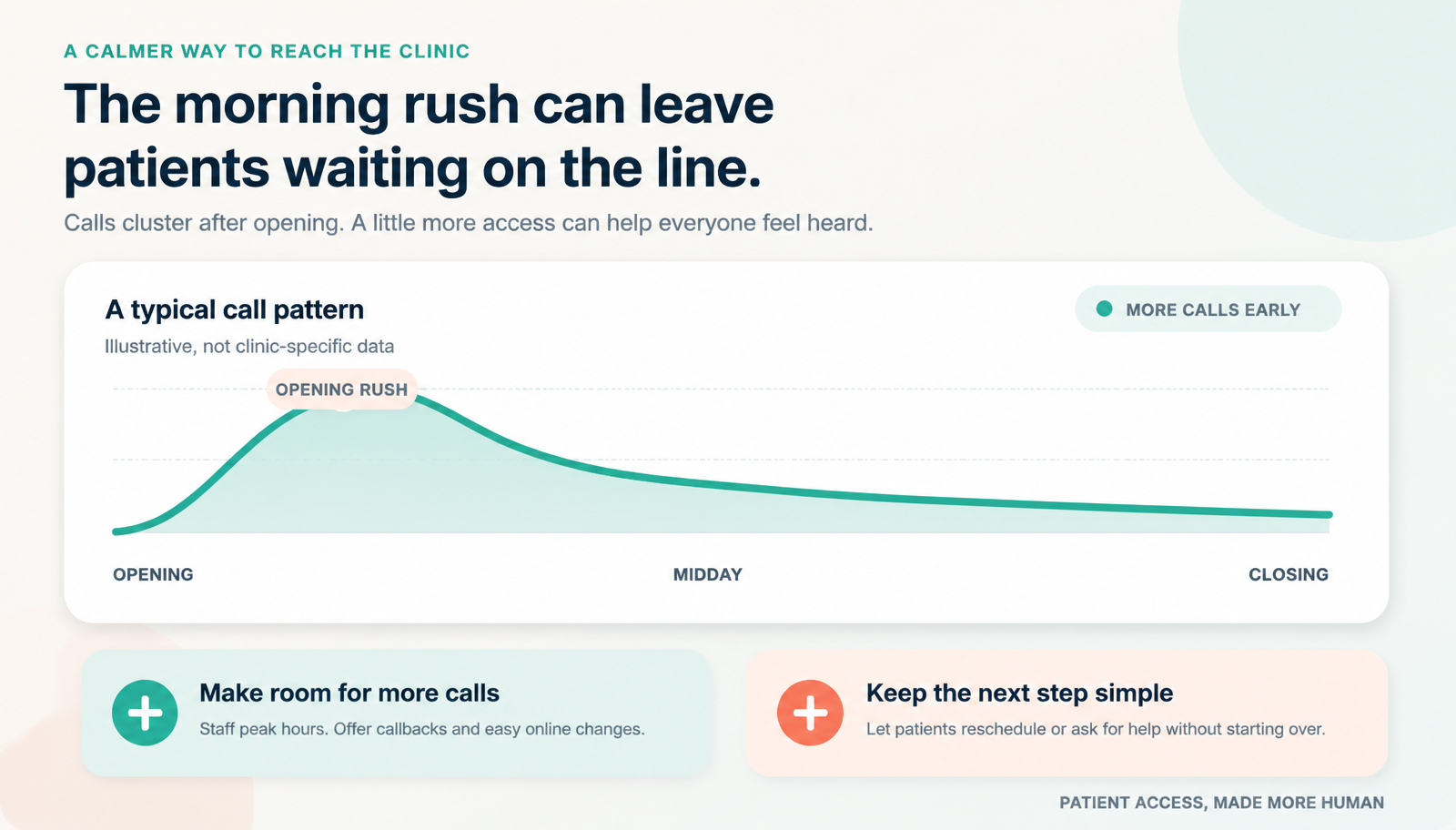
- Call volume bunches up. Monday mornings and the hour after opening carry far more calls than mid-afternoon. Example: two staff can handle a 2 p.m. trickle, but not every patient who woke up sick calling at 8 a.m.
- One line does everything. Booking, billing, refills, and test results share one queue. Example: a two-minute reschedule waits behind a ten-minute billing dispute.
- Each call takes too long. At HealthBridge, the average call took 4 minutes 20 seconds before any change. Example: at that length, one person can answer about 14 calls an hour at most, with no breaks.
- The front desk is also the check-in desk. Front desk staff answer phones while checking in the patient standing in front of them. Example: the line rings through a five-minute insurance check at the counter.
- After-hours calls have nowhere to go. Patients who think of booking at 9 p.m. reach voicemail. Example: HealthBridge took zero bookings after hours before it changed its setup.
How do you measure no-shows and hold time?
Track three numbers: no-show rate, average speed of answer, and abandonment rate. Your scheduling system reports the first; your phone system or call center software usually reports the other two.
| Metric | Formula | Example |
|---|---|---|
| No-show rate | (no-shows ÷ total scheduled appointments) × 100 | 96 of 1,200 = 8% |
| Average speed of answer | total seconds callers waited before an answer ÷ answered calls | 45,000 sec ÷ 600 calls = 75 sec |
| Abandonment rate | (calls where the caller hung up before an answer ÷ total incoming calls) × 100 | 90 of 690 = 13% |
Two tips make these numbers useful:
- Count late cancellations separately from no-shows. That shows whether reminders are turning no-shows into cancellations you can still refill.
- Track phone numbers by hour of day, not as a monthly average. The monthly figure hides the Monday morning spike that does most of the damage.
How can clinics reduce no-shows and hold time? 8 practical ways
Fix the phone line and the calendar together. Start with the way that matches your biggest cause above.
- Send reminders patients can reply to
- Make cancelling as easy as booking
- Refill empty slots from a cancellation list
- Offer patient self scheduling
- Pick the right scheduling model
- Set a clear no-show policy
- Staff the phones for the peak
- Answer every call, including after hours
1. Do appointment reminders actually reduce no-shows?
Yes, and reminders patients can reply to work best. A 2026 meta-analysis of 10 studies found reminded patients were about 11% more likely to attend than those with no reminder. Telephone reminders showed a clear, consistent effect. Text message appointment reminders trended positive, but the result was not statistically significant.
What to do: Send automated appointment reminders 48 to 72 hours before the visit and again the day before. Let patients confirm, cancel, or reschedule from the reminder itself.
Example: "Reply 1 to confirm, 2 to reschedule." A patient who replies 2 gets three open times and picks one. The old slot goes back on the calendar the same minute.
2. How do you make cancelling as easy as booking?
Give patients a way to cancel or reschedule at any hour, without a hold queue.
What to do: Offer at least two cancel paths that work outside office hours: a reminder reply, an online link, or a phone line that always answers. Put the cancel option in every confirmation and reminder.
Example: A patient wakes up sick at 6 a.m. and cancels her 9 a.m. visit before the office opens. The clinic now has three hours to fill the slot instead of finding it empty at 9:15.
3. How do you refill cancelled appointment slots?
Keep a cancellation list of patients who want an earlier visit, and offer each open slot in order until it is taken. MGMA found that some groups with lower no-show rates filled vacant slots as they occurred.
What to do: Ask every patient booked more than a week out if they want an earlier slot. Add those who say yes to a cancellation list with their visit type and preferred times. When a slot opens, contact the list in order.
Example: A dermatology clinic has 14 patients on its list. A Thursday 2 p.m. visit is cancelled on Wednesday afternoon. The first patient on the list takes it within the hour.
4. Should clinics offer patient self scheduling?
Yes, for simple visit types. Patient self scheduling moves routine booking off the phone line, so every online booking is one fewer caller in the 8 a.m. queue.
What to do: Open online booking, rescheduling, and cancelling for visit types with a fixed length, such as follow-ups, annual check-ups, and vaccinations. Keep new-patient and complex visits on a guided path so they get the right slot length.
Example: A primary care practice opens online booking for annual physicals only. Calls to book physicals stop competing with sick-visit calls on Monday mornings.
5. Which patient scheduling model works best?
The one that matches your no-show pattern and visit mix. Many clinics combine models by time of day.
What to do: Pull your no-show rate by day, time, and visit type. Then pick a model for each block using this table:
| Model | How it works | Best for | Watch out for |
|---|---|---|---|
| Stream (fixed slots) | One patient per slot, evenly spaced | Low no-show clinics, procedures | Every no-show leaves idle time |
| Wave scheduling | Several patients booked at the top of each hour, seen in order of arrival | Clinics with frequent late arrivals | Waiting room fills at the top of the hour |
| Modified wave scheduling | Two or three patients at the top of the hour, the rest spaced through it | Busy primary care | Needs steady visit lengths |
| Cluster scheduling | Similar visit types grouped into one block (for example, all vaccinations 9 to 11 a.m.) | Many short, similar visits | Less flexible for patients |
| Open access scheduling | A large share of slots kept open for same-day appointments | Clinics where long waits for a visit drive no-shows | Harder to plan staffing ahead |
| Double booking | Two patients in one slot where no-shows are predictable | Visit types with known high no-show rates | Long waits when both show up |
Example: A clinic finds Monday 8 a.m. follow-ups have its highest no-show rate. It uses modified wave scheduling for that block and keeps the rest of the day on fixed slots.
6. Should clinics charge a no-show fee?
Many do, and a fee works best when cancelling is easy. According to MGMA, 42% of practices charge a no-show fee, and its guidance suggests fees in primary care might range from $25 to $50. Without an easy way to cancel, a fee penalizes patients who tried and couldn't get through.
What to do: Write a short no-show policy for your medical office: the cancellation window, what counts as a no-show, and whether a fee applies. Share it at booking and in every reminder.
Example: "Please cancel at least 24 hours ahead. After two missed visits without notice, a $25 fee applies."
7. How can clinics cut hold times during peak hours?
Staff the phones for the peak, not the average, and take routine calls out of the main queue.
What to do: Use your hour-by-hour call data to add people during peaks. Move billing and records requests to a callback line. Larger groups often use centralized scheduling, one team that books for every location, so calls don't wait on one busy front desk.
Example: A four-provider practice moves one staff member from filing to phones from 8 to 10 a.m., Monday to Wednesday, and sends billing questions to a callback line. Booking calls stop queuing behind billing calls, and morning hang-ups drop.
8. Can an AI voice agent handle patient scheduling calls?
Yes, for routine booking, rescheduling, and cancelling, with complex or urgent calls handed to a person. An AI voice agent answers on the first ring, books in your live calendar, and covers nights and weekends when the office is closed. Hold time drops because no caller waits for a free staff member, and late cancellations reach the calendar in time to refill.
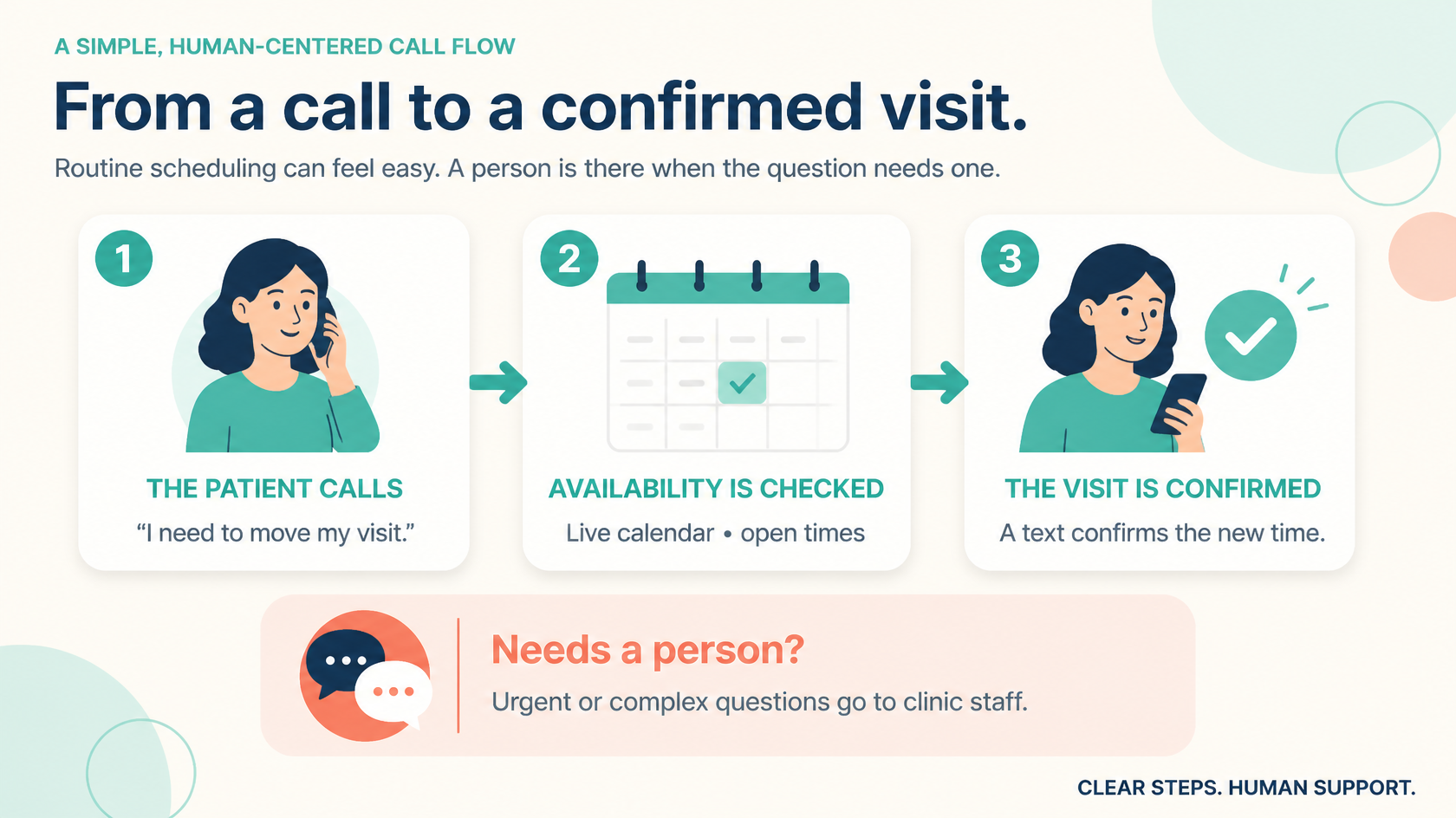
What to do: Start with overflow and after-hours calls. Connect the agent to your calendar, list the call types it should hand to staff (clinical questions, emergencies, billing disputes), and review transcripts weekly for the first month.
Example: A patient calls at 7:30 p.m. to move Thursday's visit. The agent finds Friday at 11 a.m., confirms it, sends a text confirmation, and frees Thursday's slot for the cancellation list.
For a plain explainer, see what an AI voice agent is. For the cost compared with hiring, see the AI receptionist cost breakdown. If you're replacing a press-1 phone menu, what IVR is explains the difference.
What does this look like in a real clinic?
HealthBridge cut its missed call rate from 28% to 3% in 90 days. The group runs five outpatient clinics. It put Zoxa voice agents on all five inbound lines, connected to Epic (its electronic health record, or EHR), Google Calendar, Twilio, and Slack, in English, Hindi, and Punjabi. Setup took one afternoon.
The agent books in real time and sends a text confirmation. It also handles reschedules and cancellations without a hold queue, works nights and weekends, and hands complex medical questions and emergencies to staff.
| Metric (first 90 days) | Before | After |
|---|---|---|
| Missed call rate | 28% | 3% |
| Appointments booked per month | 1,420 | 1,560 (+140) |
| After-hours bookings per month | 0 | 210 |
| Average call handling time | 4 min 20 sec | 1 min 38 sec |
| Share of calls handled by front desk | 100% | 41% |
HealthBridge is also piloting outbound calls to patients due for annual check-ups. Those calls book 34% of patients reached, compared with 8% from its earlier text reminders.
"We were losing patients before they even walked through the door," said Sarah Chen, Practice Operations Manager. Read the full HealthBridge case study.
Frequently asked questions
What is a good no-show rate for a medical practice?
There is no single official US benchmark, so your own baseline is the number to beat. A systematic review found an average of roughly 23% across studies worldwide, with wide swings by region and specialty. Measure your current no-show rate, then track it month over month after each change.
What is a good average speed of answer for a clinic phone line?
The Veterans Health Administration targets 30 seconds or less, with no more than 5% of callers hanging up. In the VA study, average speed of answer improved from 87 seconds to 69 seconds but stayed above that goal, while abandonment fell from 12.0% to 8.3%.
Is double booking patients a good idea?
Only for visit types where your data shows predictable no-shows. If both patients arrive, one waits, which hurts the patient experience. Fixing the cause (reminders, easy cancelling, a cancellation list) usually beats booking around it.
Do text reminders work as well as phone call reminders?
Not always. In the 2026 meta-analysis, phone reminders showed a significant improvement in attendance, while text-only reminders showed a positive trend that was not statistically significant. Many clinics use both: a text the patient can reply to, plus a call for visits that are often missed.
Where should a clinic start?
Measure first, then fix your single biggest gap. Track your no-show rate, average speed of answer, and abandonment rate by hour for two weeks. Then pick the one fix above that matches what the numbers show. If unanswered and after-hours calls are the gap, you can book a Zoxa demo to hear an AI voice agent handle scheduling calls.