What Is IVR? Why AI Voice Agents Are Replacing Press-1 Menus
IVR stands for Interactive Voice Response: the automated phone menu that asks you to press 1 for sales, press 2 for support. It routes calls and plays recordings, but it cannot hold a real conversation or finish a task. Here is how it works, and what comes next.
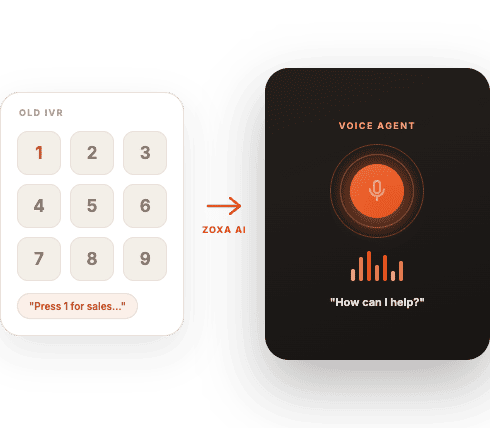
The short answer. IVR stands for Interactive Voice Response: the automated phone menu that answers a call and asks you to "press 1 for sales, press 2 for support." It routes the call and plays recordings, but it cannot hold a real conversation or finish a task. A newer option, the AI voice agent, lets callers just say what they want and gets it done on the call.
You have met IVR many times. You call a bank, a clinic, or a telecom helpline, and a recorded voice reads out a list of options. You tap a number, wait, tap another, and maybe reach a person. That menu is an IVR. This guide explains what IVR is, how an IVR call works, where press-1 menus fall short, the rules that apply in India, and how AI voice agents change the experience.
What is IVR?
IVR full form: Interactive Voice Response. It is phone software that answers calls automatically, plays recorded prompts, and lets the caller respond by pressing keypad digits (called DTMF tones) or, in newer systems, by speaking a few set words.
A classic IVR does three jobs:
- Greets the caller with a recorded message ("Thank you for calling…").
- Offers a menu of numbered choices.
- Routes the call to a department, plays information, or sends the caller to voicemail.
It is the automated front desk of the phone world: useful for sorting calls, but it does not understand plain speech and it cannot complete the actual task on its own.
How an IVR call works
One IVR call usually runs through the same few steps:
- The call connects to a phone number that points at the IVR system.
- A recorded greeting plays, followed by a menu: "Press 1 for sales, press 2 for support."
- The caller presses a key. The tone tells the system which branch to follow.
- The system acts on the choice: it plays more options, reads out information (like account balance or opening hours), or forwards the call to an agent or queue.
- If no option fits, the caller waits for a human, leaves a voicemail, or hangs up.
Everything the IVR can do is decided in advance by the menu tree. If your need is not on the menu, the IVR cannot help.
What IVR is good at
IVR has been around for decades because it does some things well:
- Sorting high call volume into the right department.
- Answering fixed questions like store hours or a balance, 24/7.
- Self-service for simple, structured tasks, such as checking an OTP status or recharging a number.
- Keeping costs down when most calls are routine and repetitive.
For a business with a small set of predictable call types, a well-built IVR is still a sensible tool.
Where press-1 menus fall short
The weak spots show up the moment a call does not fit the menu:
- Callers have to adapt to the machine. You must translate your real question ("can I move my appointment to Thursday?") into a menu path, if one even exists.
- Long menus lose people. Deep menu trees ("press 4, then press 2, then press 1") make callers give up or "press 0" to escape to a human.
- No real understanding. A keypad menu cannot grasp "my order hasn't arrived" or "I want to reschedule." It only knows which key you pressed.
- It rarely finishes the job. Most IVRs route or inform; they do not book, reschedule, or update records. A person still has to do the work.
- One language, one script. Changing languages or wording means re-recording the whole tree.
This is why so many callers dread the phone menu, and why "conversational" options have appeared.
IVR in India: the rules you should know
IVR is woven into Indian phone life, on both sides of the call.
- Managing Do Not Disturb (DND): you can register or deregister for DND by dialling 1909 and following the IVR prompts, then confirming by SMS. Complaints about unwanted calls can also be filed through an IVR line.
- Business calls are regulated by TRAI. Automated and prerecorded calls are treated as application-to-person (A2P) calls. Senders generally have to register in advance, and the rules were tightened further in 2026.
- Promotional calls run on DND scrubbing and a time window. Promotional calls must respect the national DND registry and are commonly restricted to roughly 9 a.m. to 9 p.m. IST. Transactional calls, like an OTP or a delivery update, are treated differently.
Rules change, so confirm the current obligations with TRAI or a legal adviser before you run any outbound campaign. If you also call customers in the US, see our TCPA compliance checklist.
Conversational IVR vs an AI voice agent
"Conversational IVR" is a middle step: it adds speech recognition so callers can say a word or short phrase instead of pressing a key. It is friendlier than a keypad menu, but it usually still follows a fixed script and hands off anything complex.
An AI voice agent goes further. It holds a natural conversation, understands plain speech, and completes the task during the call. (New to the idea? Read our plain-English guide to AI voice agents.)
| What the caller gets | Classic IVR | Conversational IVR | AI voice agent |
|---|---|---|---|
| How you respond | Press a key | Say a set word | Just talk, naturally |
| Understands plain speech | No | Limited | Yes |
| Finishes the task (books, reschedules, updates) | No | Rarely | Yes, on the call |
| Languages | One per recording | A few | 100+, detected automatically (Zoxa) |
| Handover to a person | Transfer only | Transfer only | Warm handover with the full transcript |
| Feels like | A menu | A smarter menu | A conversation |
When to upgrade from IVR to an AI voice agent
Stay with an IVR if your calls are few, fixed, and purely about routing. Consider an AI voice agent when:
- Callers want to do things, not just be routed: book, reschedule, check an order, get a real answer.
- Menus are getting long, and more people are pressing 0 to reach a human.
- Calls spike after a campaign or at certain hours, and the queue grows.
- Your callers speak several languages.
- You want the call to end with the job done, with notes and a transcript in your system.
On Zoxa, the agent replies in under 1.5 seconds, speaks 100+ languages, reads your live calendar to book real slots, and hands complex calls to a person with the transcript attached. See how Zoxa voice agents handle booking and handover, or weigh the people-vs-AI choice in telephone answering service or AI voice agent.
Frequently asked questions
What is the full form of IVR?
IVR stands for Interactive Voice Response. It is phone software that answers calls, plays recorded prompts, and lets callers respond by pressing keypad digits or saying set words.
How does an IVR call work?
The call connects to the IVR, a recorded menu plays ("press 1 for sales"), the caller presses a key, and the system routes the call, reads out information, or forwards it to an agent. Everything it can do is set by the menu tree in advance.
What is conversational IVR?
Conversational IVR adds speech recognition so callers can say a word or short phrase instead of pressing a key. It is friendlier than a keypad menu but usually still follows a fixed script, unlike an AI voice agent that holds a full conversation and completes the task.
Is IVR still useful?
Yes, for high call volume and simple, structured tasks like routing calls or reading out fixed information. It falls short when callers need to explain something in their own words or want the task finished on the call.
What is the difference between IVR and an AI voice agent?
An IVR routes calls and plays recordings based on which key you press. An AI voice agent understands natural speech, answers questions, and completes tasks like booking an appointment during the call, then hands over to a person when needed.
Are IVR calls allowed under DND in India?
Promotional automated calls must respect the national DND registry and the allowed calling window, and senders must follow TRAI's registration rules. Transactional calls, such as an OTP, are treated differently. Check TRAI's current rules before running any campaign.
From press-1 to plain talk
IVR solved a real problem: it stopped every call from needing a person and sorted the phone line. But a keypad menu still makes the caller do the work, and it rarely finishes the task. An AI voice agent flips that around: the caller just talks, and the call ends with an answer, a booking, or a smooth handover.
Want to hear the difference? Start free with Zoxa and call an agent that listens, answers, and gets the job done, no menu required.