AI Receptionist Cost vs a $55,000 Human Receptionist
A receptionist you pay about $18 an hour really costs around $55,000 a year once you add taxes, benefits and after-hours cover. An AI receptionist handles the same phone work around the clock for about $600 to $2,400. Here is the honest breakdown.
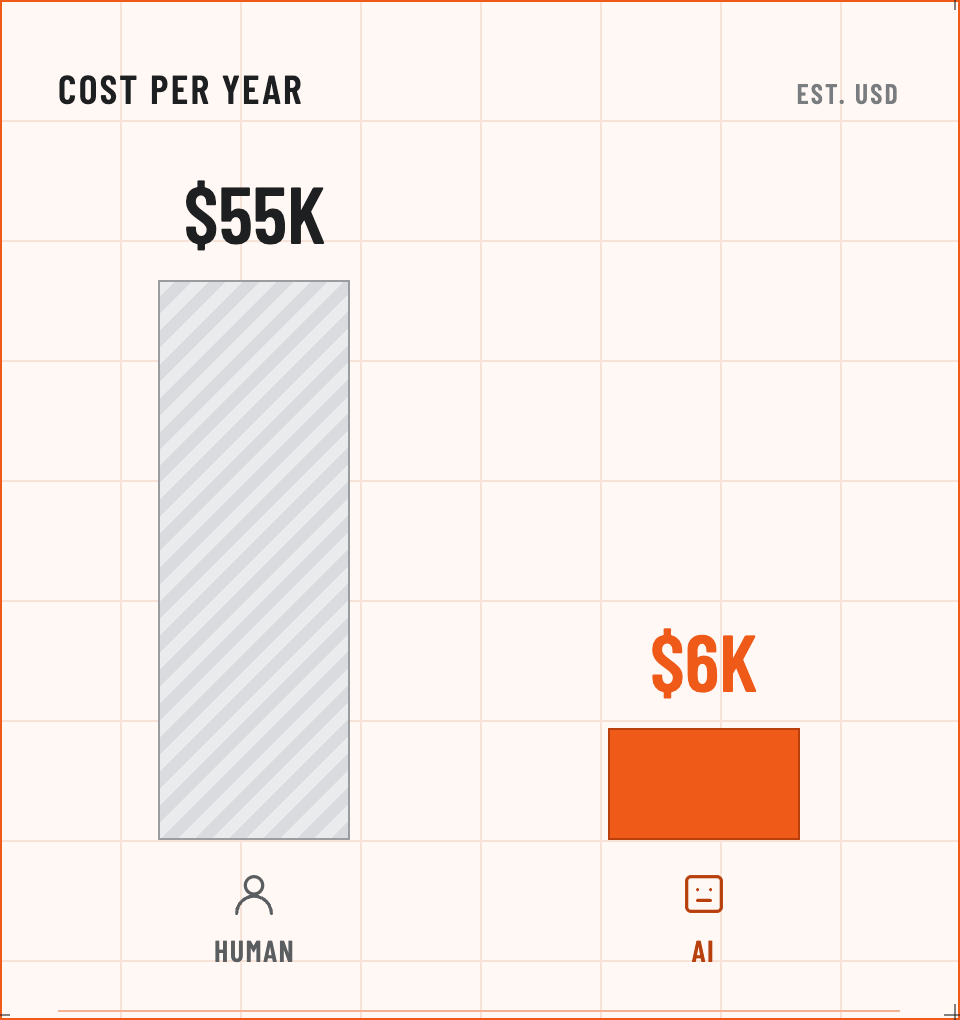
The real cost of a receptionist is easy to underestimate. A receptionist you pay about $18 an hour looks affordable on paper. Once you add taxes, benefits, and the calls that come in after hours, the full cost of that role is closer to $55,000 a year. An AI receptionist handles the same phone work, around the clock, for about $600 to $2,400 a year.
Both options have a real place. This guide lays out the numbers for each, plainly, so you can decide what fits your business. All figures are in US dollars.
Here is the quick view:
| Option | Cost per year | Hours covered | Handles a rush of calls? |
|---|---|---|---|
| In-house human receptionist | ~$55,000 | Work hours, one person | No |
| Human answering service | $4,800 to $10,800 | Can be 24/7 | Some |
| AI receptionist | $600 to $2,400 | 24/7 | Yes |
The true cost of a human receptionist
A salary is the visible part of the cost. A few others sit underneath it.
In the US, the median pay for a receptionist is $38,010 a year, or $18.27 an hour, according to US Bureau of Labor Statistics data. That is the figure most budgets start with.
On top of the wage come benefits and payroll taxes. Across US workers, those add up to 31.4% of total pay, per Bureau of Labor Statistics figures — things like health insurance, paid time off, and Social Security. Add those in, and the real cost of the role is about $55,000 a year.
That covers one person, on one shift. A single hire naturally has limits:
| The role covers | It cannot cover alone |
|---|---|
| About 40 hours a week | Nights, weekends, and holidays |
| One call at a time | A second caller ringing at once |
| A steady daytime desk | Days off, sick leave, and holidays |
| The work once trained | The first few weeks of ramp-up |
None of this is a knock on receptionists. A good one is a real asset. It simply means the full cost of the role is higher than the hourly rate suggests, and one person can only be in one place at a time.
The cost of an AI receptionist
An AI receptionist covers the phone for a monthly software fee.
It answers in a natural voice, takes messages, books appointments, and passes urgent calls to a person. There is no wage or desk. You pay for the software, and it runs on every line at once.
Most plans cost $25 to $300 a month. Full-featured ones sit around $50 to $200 a month, or about $600 to $2,400 a year.
The billing also works differently. A human answering service usually charges by the minute or the call, so a busy month costs more. AI pricing is mostly flat. You pay a set fee, it takes many calls at the same time, and the bill stays steady when volume climbs.
| Pricing type | How it works | Best for |
|---|---|---|
| Flat monthly | One set fee with a call or minute limit | Steady, predictable volume |
| Per minute | You pay for the talk time you use | Low or uneven volume |
| Per seat | A small fee per number or agent | Teams adding lines over time |
One thing worth checking before you sign up: what happens if you go over your plan. Look at the overage rate and any setup fee so the flat price stays flat.
Here is the same small business, with about 100 calls a month, across all three options:
| Cost item | In-house human | Answering service | AI receptionist |
|---|---|---|---|
| Base cost | $38,010 wage | $400 to $900 / month | $50 to $200 / month |
| Benefits and taxes | + ~31% (~$12,000) | Built in | None |
| After-hours cover | Second hire needed | Extra minutes | Built in |
| Handles a call rush | No | Some | Yes |
| Total per year | ~$55,000 | $4,800 to $10,800 | $600 to $2,400 |
The price difference is large, but price is only part of the picture. The next part looks at a cost that does not show up on any invoice.
The coverage gap problem
The calls that go unanswered are easy to miss, because they never show up on a bill.
A single receptionist can only do so much. They take lunch, they help someone at the desk, they finish at 5. In those moments, calls go to voicemail, and many callers simply try someone else. That is not a failing of the person. It is what happens when one line meets more demand than one person can hold.
After hours is the clearest example. A day-shift hire cannot answer nights and weekends, so those hours stay uncovered unless you add a second shift. An AI receptionist answers them at no extra cost.
Here is a simple way to size your own gap. Say you miss 5 calls a day. Say 1 in 4 of those callers would have booked. Say a customer is worth $200 to you.
- 5 missed calls a day, over about 20 work days, is 100 missed calls a month.
- If 1 in 4 would have booked, that is 25 potential customers.
- At $200 each, that is about $5,000 in missed business a month.
Swap in your own numbers. For many businesses, the value of the calls that slip through is larger than the cost of the phone cover itself.
A real example. HealthBridge Clinic runs five outpatient sites and was stretched at peak hours. More than 1 in 4 calls went unanswered, and nights and weekends had no cover. They added AI voice agents to catch overflow and after-hours calls, and kept their team on the calls that needed a person. The results over the pilot:
| Measure | Before | After |
|---|---|---|
| Missed-call rate | 28% | 3% |
| Average call time | 4 min 20 sec | 1 min 38 sec |
| After-hours bookings | 0 per month | 210 per month |
| Setup time | n/a | One afternoon |
Those 210 after-hours bookings were simply unreachable before. Covering them with staff would have meant paying for evening and weekend shifts on top of the day desk.
What about call quality?
This is a fair question, and it deserves an honest answer.
Early phone systems were frustrating, and that memory is real. Today's voice agents are a step up. They reply in about a second, speak naturally, and understand plain speech instead of a "press 1, press 2" menu. Many callers do not realize they are speaking with software, and you can have the agent introduce itself as an assistant if you prefer to be upfront.
HealthBridge is a useful signal here. Average call time fell from 4 minutes 20 seconds to 1 minute 38 seconds — not because callers were rushed, but because they got their answer without holds or transfers.
The honest limit: a human is still better for a sensitive, emotional, or unusual call. That is exactly what handover is for. A good setup lets AI take the routine calls and hand the rest to a person, with the full call history attached. That is the thinking behind Zoxa voice agents with built-in handover.
When human receptionists make sense
Sometimes a person is clearly the right choice, and it is worth being honest about that.
A human receptionist is well worth the cost when the job is about more than the phone:
- You run a front desk with walk-ins who value a friendly face in person.
- Many of your calls are sensitive, emotional, or one of a kind.
- The role includes in-person work, like greeting guests, handling mail, or taking payments.
- Your callers expect a person, and that personal touch is part of your brand.
A simple way to think about the fit:
| Your situation | Better fit |
|---|---|
| Front desk with regular walk-ins | Human receptionist |
| High call volume or long hours | AI receptionist |
| Calls that spike at certain times | AI receptionist |
| Limited budget, every call matters | AI receptionist |
| Sensitive, personal, high-touch calls | Human, with AI as backup |
For many businesses, it is not either/or. A person handles the front desk and the calls that need care. AI covers the overflow, the after-hours, and the second caller who would otherwise reach voicemail.
Which one is right for you?
Start with one number: what a booked call is worth to you.
If your phone is calm and a person greets every caller well, your current setup is serving you. There is no need to change it.
If calls stack up, arrive after hours, or slip to voicemail, the numbers make a strong case for AI. You gain around-the-clock cover and steady, low monthly cost. A human answering service is a middle path: more coverage than a single hire, though you pay by the minute as volume grows.
In the end, the goal is simple: make sure every caller reaches you. If you would like to see how an AI receptionist handles that, you can set one up with Zoxa and hear it answer a live call in a few minutes.
Frequently asked questions
How much does an AI receptionist cost per month?
Most plans run $25 to $300 a month, with full-featured options around $50 to $200. The price is usually flat, so a busy month does not raise the bill.
Is an AI receptionist cheaper than hiring someone?
Usually, yes. A full-time in-house receptionist costs about $55,000 a year with benefits and taxes. An AI receptionist covers the phone for a small part of that and works around the clock. A human still brings value that software cannot, so the right choice depends on your needs.
What is the difference between an AI receptionist and a virtual receptionist?
A virtual receptionist is usually a real person working remotely through an answering service, billed by the minute or call. An AI receptionist is software that answers on its own, for a flat monthly fee.
Can an AI receptionist transfer calls to a real person?
Yes. A good one handles routine calls and passes anything urgent or sensitive to a team member, with the caller's details and what was said.
Do I have to replace my receptionist to use an AI one?
No. Many businesses keep their receptionist for the front desk and use AI for overflow, after-hours, and second callers who would otherwise reach voicemail. The two work well side by side.
Does an AI receptionist work after hours?
Yes, and that is often where it helps most. It answers nights, weekends, and holidays at no extra cost — hours a single day-shift hire cannot cover.
Conclusion
The choice is not really human versus AI. It is about which one keeps your phone answered at a cost that makes sense.
A human receptionist brings warmth, judgment, and a real presence at the desk, and for some businesses that is worth every dollar of the roughly $55,000 a year the role costs. An AI receptionist brings round-the-clock cover and steady, low pricing, usually $600 to $2,400 a year, and never lets a call go unanswered.
For most businesses with steady call volume or after-hours demand, the strongest setup uses both: a person for the calls that need a human touch, and AI for everything else. Start by putting a number on what a missed call is worth to you. That single figure will tell you, more than any price tag, which mix is right.