What Is an AI Voice Agent? A Plain-English Guide for 2026
An AI voice agent answers a phone call and talks to the caller the way a person would — then actually does the task: books the appointment, checks the order, or hands off to a human when it can't.
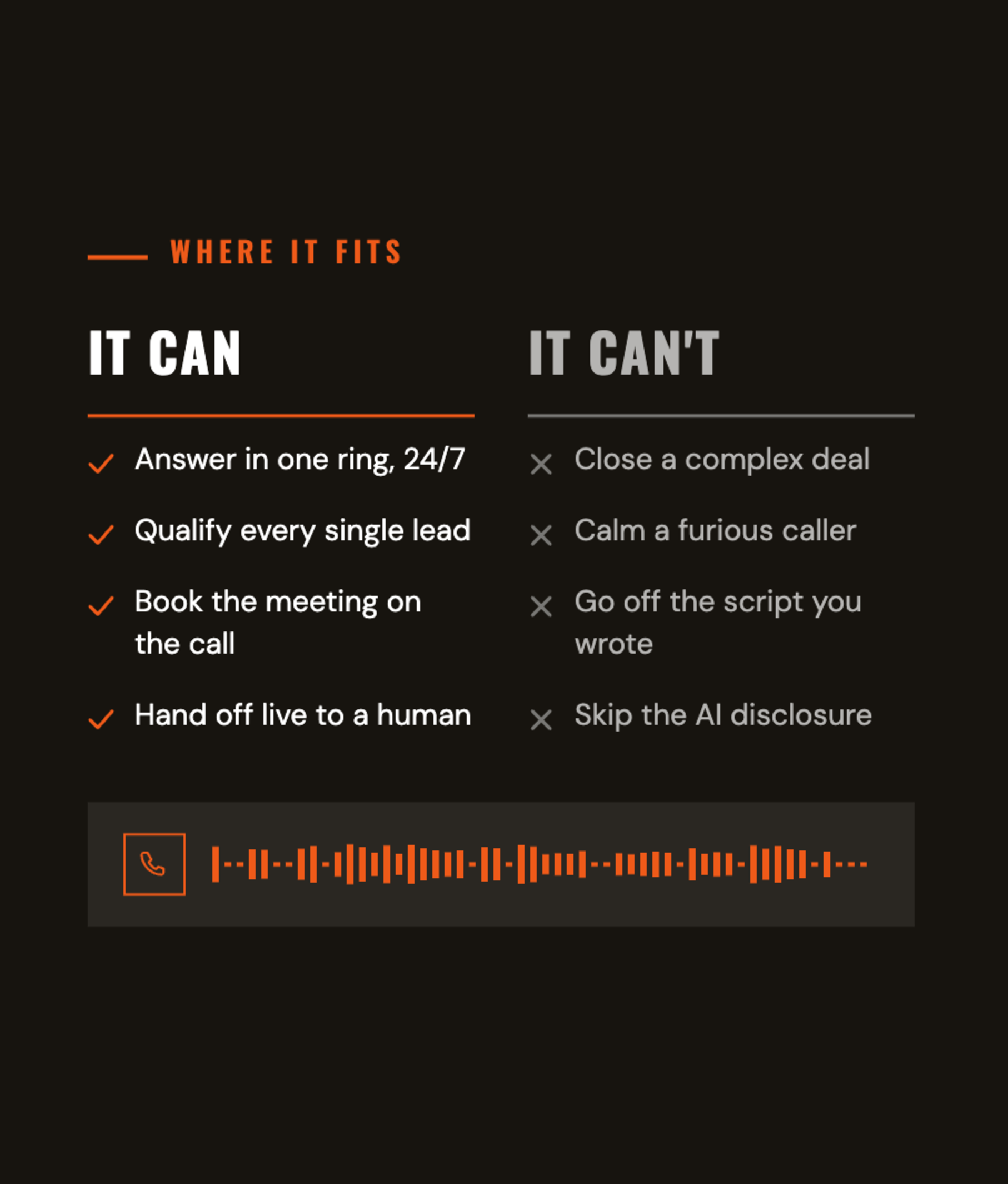
The short version. An AI voice agent is software that answers a phone call and talks to the caller the way a person would. It hears what they say, works out what they want, replies out loud, and then does the task: books the appointment, checks the order, or transfers the call to a human when it cannot handle the situation. The older stuff it gets confused with, phone menus and recorded messages, can't do any of that.
You've probably had one of these calls already without being told. Maybe you called a dentist after hours. An automated voice answered, took your details, and booked your appointment.
The technology went from a research demo to something you can switch on in an afternoon in about two years. The forecasts explain why everyone is suddenly talking about it.
Deloitte asked 3,235 business and IT leaders across 24 countries about their plans. Three out of four businesses expect to use AI agents within the next two years (Deloitte, 2026).
Gartner says AI agents may handle 80% of common customer issues on their own by 2029. This could also reduce operating costs by about one-third (Gartner, 2025).
Phone lines are where a lot of this lands first. This guide explains AI voice agents, how they work, what they can and cannot do, and what to check before using one.
What is an AI voice agent?
An AI voice agent is software that holds a phone conversation and completes the task at the end of it.
That definition gets stretched, though. A lot of products call themselves voice agents when they're closer to a talking menu. Four questions separate them.
| # | The question | A real one | Not one |
|---|---|---|---|
| 1 | Can the caller just talk? | Explains their needs naturally | "Press 1 for sales" |
| 2 | Does it get the meaning? | "Move my Thursday appointment" and "can we push this week's visit" land the same way | It only reacts to certain words |
| 3 | Is it quick? | Replies in about one second, in the caller's language | Waits three seconds, then speaks like a robot |
| 4 | Does anything happen? | Updates the calendar, saves the change, and sends a confirmation | It only chats. Someone still has to do the work. |
Question 4 is the one that separates this generation from the last.
Voice bots have been able to hold a passable conversation for years. What they couldn't do was reach into a calendar or an order system and change something. AI agents can now book appointments during a call. They don't just leave a message for someone else to handle.
The words people mix up
Half the confusion in this topic is vocabulary. Vendors invent names, and a lot of them describe the same product.
| Term | What it means |
|---|---|
| AI voice agent | The general name for the category |
| Voice AI agent, AI phone agent, agentic voice AI | Same thing, different marketing team |
| AI receptionist | A voice agent doing front-desk work |
| AI call center agent | A voice agent handling high call volume |
| Conversational AI | The wider category. Covers chat and text too, not just phone |
| Voice bot | Usually the older generation. Talks, but can't act |
| IVR | The press-1 phone menu. Not AI at all, though it gets grouped in |
If you need AI to answer phone calls, make sure the service can do that.
How is it different from phone menus, chatbots, and robocalls?
These all touch the phone or the customer, so they get lumped together. The differences are large.
| What the caller does | Can it finish the job? | Is it on the phone? | |
|---|---|---|---|
| Phone menu (IVR) | Taps numbers, hopes for the best | No. It only routes | Yes |
| Voicemail | Leaves a message, waits | No. It builds a callback pile | Yes |
| Website chatbot | Types | Text tasks only | No |
| Robocall | Listens to a recording | No. One message, that's it | Yes |
| AI voice agent | Talks normally | Yes. Books, updates, transfers | Yes |
There's a quick test that sorts them. Interrupt halfway through with a completely different question. A phone menu falls apart. A recording carries on regardless. A real agent stops, listens, and answers the new question.
How an AI voice agent works
One call, five steps, repeated roughly every two seconds while people are talking.
| Step | What happens | What's doing it |
|---|---|---|
| 1. Picks up | The agent sits on a phone number | A phone service like Twilio or Plivo |
| 2. Listens | Writes down what the caller says while they're still saying it | Speech-to-text |
| 3. Understands the caller | Listens to the caller and checks their details | Uses AI and business tools |
| 4. Replies | Speaks back in the caller's language, and stops the moment they interrupt | A voice model |
| 5. Finishes the work | Saves the details and sends a message | Uses business tools like calendars and email |
Step 3 is where the difference lives
The AI isn't choosing a sentence. It's choosing what to do.
Caller says "my order hasn't turned up." The agent asks for the order number, looks it up in the order system, and reads back what's really there. Not a scripted apology.
Caller says "can I come in Thursday?" It checks what's genuinely free, offers those times, and books one.
Remove the connection to the order system or the calendar and step 3 collapses. The agent can still chat. It just can't help. Before choosing an AI agent, check if it works with your current tools.
Why speed decides how it feels
Those five steps run again every time someone speaks. When step 3 is slow, you get dead air, and dead air is where callers talk over each other or hang up.
Around one second feels like a conversation. Three seconds feels like a machine. It's the single most useful number to ask any vendor for, and the one most of them bury.
What AI voice agents are used for
Two directions, and most businesses turn on one before the other.
Calls coming in
| The job | What the agent does |
|---|---|
| Answering at all hours | Picks up at night, at weekends, on holidays |
| Bookings | Books, moves and cancels against what's genuinely free |
| Routine questions | Order status, opening hours, location, prices |
| New enquiries | Works out whether it's worth a salesperson's time, then passes it across |
| Busy periods | Takes the calls when every human line is engaged |
| Handing over | Sends the call to a person with the transcript attached |
Calls going out
| The job | What the agent does |
|---|---|
| Reminders and recalls | Works through a list, books the return visit |
| Fast follow-up | Calls back within minutes of someone filling in a form |
| Confirmations | Payment, delivery, appointment |
| Hiring calls | Runs first-round phone screens, hundreds at a time. Walked through in how AI recruiters screen candidates by phone |
The pattern is the same underneath. These are calls that repeat, follow a shape, and arrive in volume. A one-off negotiation is not on that list, and shouldn't be.
What AI voice agents can't do
Worth reading before the demo, not after.
| What it can't do | Why |
|---|---|
| Calm down an angry caller | It can spot the tone and get out of the way. It shouldn't try to win the argument |
| Make a judgement call | Goodwill refunds, bending a rule, anything unusual. Those stay with a person |
| Use a system nobody connected | No calendar link means no bookings. Most disappointing rollouts trace back to a missing connection rather than the AI |
| Fix a messy process | If your booking rules are unclear, the AI may give callers the wrong information |
| Run unsupervised from day one | The transcripts need reading weekly for the first month. Problems are usually small and fixed with one line of instruction |
Deciding where the agent hands over to a human belongs in the setup, not in the panic after the first complaint.
What realistic results look like
Vendor case studies lean hard on the best number. It helps to see the full set instead.
HealthBridge Clinic has five locations. It uses AI agents to book visits and call patients back. Over the first 90 days:
| Before | After | |
|---|---|---|
| Calls missed | 28% | 3% |
| Bookings a month | 1,420 | 1,560 |
| Bookings outside opening hours | 0 | 210 a month |
| Average call length | 4m 20s | 1m 38s |
| Calls still reaching the front desk | 100% | 41% |
Their recall campaign booked 34% of the patients it called. The text reminders it replaced were booking 8%.
Now look at what that actually says. Bookings rose about 10%, which is fine but not dramatic, and it's the number most write-ups would lead with. The two rows that matter more are further down. The front desk no longer handles 59% of calls. AI also books 210 appointments each month after hours.
That's the realistic shape of it. Not a revenue explosion. A large chunk of repetitive work moved off people, and a slice of demand captured that used to go nowhere.
How AI voice agents are priced
Almost always by the minute of conversation. Sometimes there's a monthly platform fee. Occasionally you'll see per-resolved-call pricing.
Published rates move around a lot, so the more useful exercise is working out your own break-even.
| Step | Work out | Where to find it |
|---|---|---|
| 1 | What an answered call costs you now | Salary and overheads, divided by calls actually answered last month |
| 2 | How many calls you never picked up | Missed and abandoned, one normal month, from your phone system |
| 3 | What those were worth | Typical order or appointment value, times how often you close |
| 4 | What an agent would cost | Per-minute rate, times how long your calls really run |
Most people compare step 1 with step 4 and stop. Step 2 often makes the biggest difference. These calls don't show up on bills, so no one counts them.
One caution on step 4. Calls may become shorter when AI handles them. HealthBridge saw this too. But use your own call times, not numbers from a demo.
The rules around AI voices on calls
This is regulated, and it changed in February 2024.
| Where | The rule | What it means |
|---|---|---|
| United States | The FCC ruled that AI-generated voices count as "artificial" under the TCPA (FCC, Feb 2024) | AI voice calls to customers need the same permission as recorded calls |
| India | TRAI's rules and the DND register | The usual consent and number-registration rules apply to outbound sales calls |
| Anywhere, inbound | The customer called you | Far fewer restrictions. This is a different situation to calling out |
Three things worth doing wherever you operate.
Say it's an automated assistant at the start of the call. It costs nothing and it prevents most complaints.
Make opt-outs work by voice, immediately, not only by replying to a text.
And ask where the call recordings go. If your business has strict rules, ask for proof of HIPAA, SOC 2, or GDPR compliance. Also ask if your call recordings are used to train AI.
How to judge one before you buy
Demos are built to look good. These five checks are harder to stage.
Call it yourself, and be difficult. Interrupt. Change your mind halfway. Mumble. Give a postcode with a letter that sounds like another letter. The failure modes show up in seconds.
Ask for the response time, in milliseconds. If the answer is a paragraph rather than a number, that tells you something.
Ask what happens when it doesn't know. A good agent says it doesn't know and passes you on. A bad one invents an answer, confidently, and you find out later.
Check the handover. Get transferred and see whether the human has the transcript or asks you to start again. This is the difference most buyers only notice after launch.
Ask which systems it connects to and how long that takes. The demo agent is connected to a demo calendar. Yours is the part that takes the time.
Is one right for your business?
| # | Question | |
|---|---|---|
| 1 | Do you miss more than one call in ten in a normal week? | ☐ |
| 2 | Do calls arrive when nobody's working? | ☐ |
| 3 | Is most of your volume the same handful of questions? | ☐ |
| 4 | Do your callers speak more than one language? | ☐ |
| 5 | Would answering everything change revenue, not just workload? | ☐ |
Three or more yeses and it's worth trialling.
A handful of complicated, high-value calls a week? Keep a person on them. The maths doesn't work and the experience would be worse.
A phone ringing all day with the same few questions, half of it outside working hours? That's the problem this was built for.
Frequently asked questions
What is an AI voice agent in simple terms?
It's a tool that answers phone calls, talks to people, and helps them get things done. For example, it can book an appointment or check an order. If it can't finish, it passes the caller to a person along with everything said so far.
How do AI voice agents work?
Five steps, repeated every time somebody speaks. The call connects through a phone service. The AI listens and understands what the caller says. It can check calendars or customer records to find answers. Then it speaks to the caller and saves the call details.
What's the difference between an AI voice agent and a phone menu?
A phone menu gives you options and sends you somewhere. That's all it does. A voice agent lets you say what you want in your own words and then sorts it out itself.
Can an AI voice agent replace a receptionist?
It takes the repetitive part off them: bookings, opening hours, order checks, the calls that come in at 9pm. Judgement calls, upset callers and anything unusual still need a person. Most teams end up with fewer boring calls rather than fewer staff.
How much does an AI voice agent cost?
Usually a per-minute rate for time spent talking, sometimes with a monthly fee. Compare the cost of your current calls with the money you lose from missed calls. Then compare it with the AI's cost based on your average call time.
Is it legal to use an AI voice on calls?
If the customer called you, yes. If you're calling them in the US, the FCC treats AI voices as artificial under the TCPA, so consent rules apply. In India, TRAI and DND rules apply. Either way, say at the start that it's an automated assistant.
Do AI voice agents work in languages other than English?
The better ones handle a hundred or more and switch automatically when the caller does. Voice quality can differ by language. Test the languages your customers speak before choosing a plan.
Zoxa builds AI voice agents for businesses that take a lot of calls. Want to hear how it works? Try our live demo, or see how the product works.