The short version. A warm transfer means the next person gets a heads-up before the caller joins. A cold transfer just passes the call along with no warning. For upset, repeat, or high-value callers, a warm transfer keeps the lead intact and prevents callers from having to repeat themselves.
TL;DR
- A warm transfer means the next person gets a heads-up before the caller joins. A cold transfer just passes the call along with no heads-up.
- Use a warm transfer for upset, repeat or high-value callers. Use a cold transfer for wrong-department calls and quick routing.
- Five9's 2026 research found that 83% of consumers at least sometimes repeat themselves after an AI agent hands them to a human.
- With an AI voice agent, a warm transfer comes down to one thing: does the caller's story reach your team with the call?
- In Zoxa, the call goes straight to your team's phone and the details travel with it. You choose when it happens, what the caller hears and how long it rings.
96% of customer-experience leaders believe their AI-to-human handoff keeps the caller's story intact. Yet 83% of consumers say they still have to repeat themselves.
That gap is where leads go cold, and a proper warm transfer closes it. The caller explained everything to a bot, got passed along, and a stranger now asks, "So, how can I help you?"
This guide covers the difference between a warm transfer and a cold transfer, when to use each, what a good handover sounds like and how Zoxa does it.
What is the difference between a warm transfer and a cold transfer?
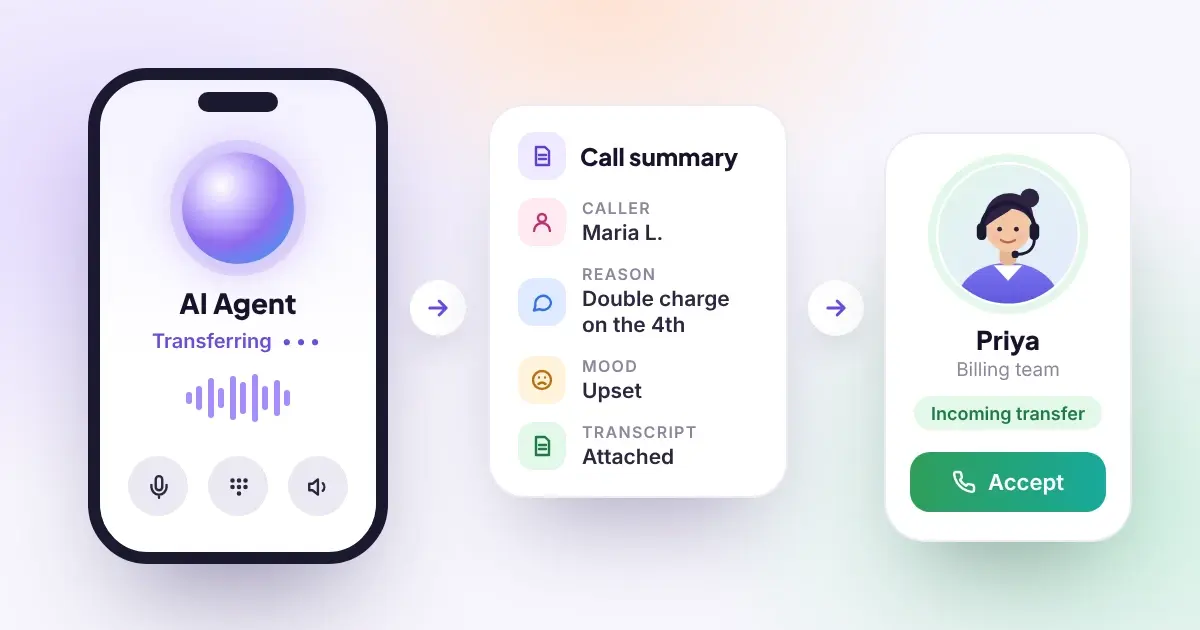
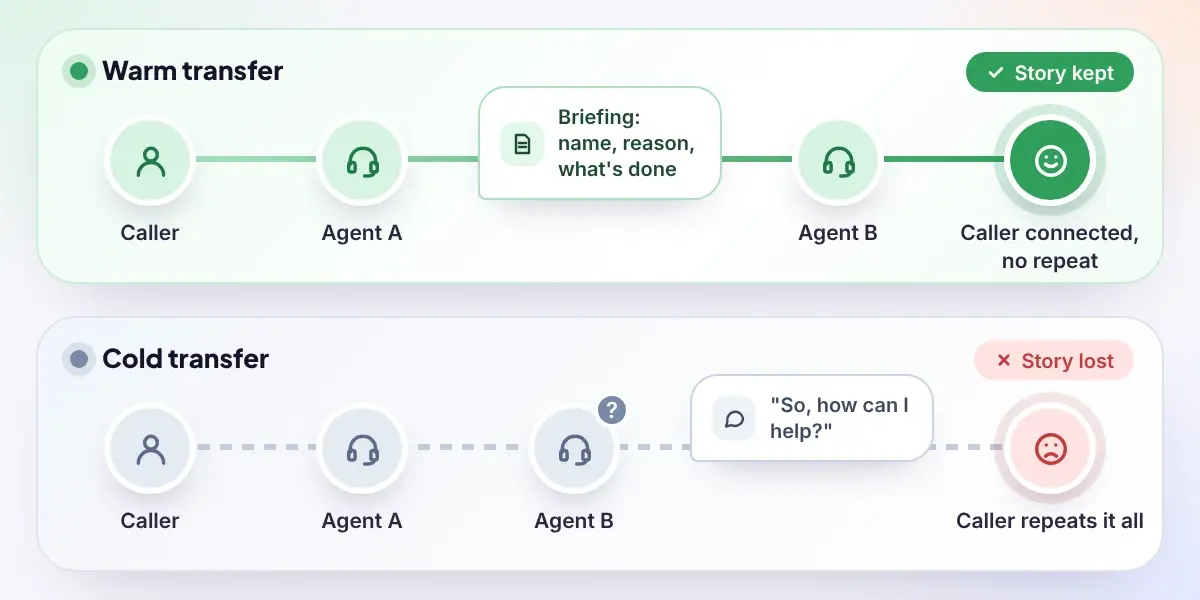
A warm transfer (also called an attended transfer) is when the first person calls ahead and fills in the next person before the caller joins. Picture a receptionist saying, "Sam, I have Maria on the line about a double charge," and only then putting her through.
A cold transfer (also called a blind transfer) is when the call is simply passed along. No heads-up, no notes. The next person picks up and starts from scratch.
The easy test for a warm transfer: after the handover, does the caller have to explain everything again? If yes, it was cold.
Two more types you will hear about
- Consult transfer. The first person calls your team privately, explains, then connects the caller. Sinch's guide explains how it works.
- Conference transfer. Everyone joins the same line for a moment, so the caller hears the introduction too.
- The AI version. Some AI tools do a warm transfer too. The AI calls your team, reads a short summary, then connects the caller. ElevenLabs does this on its Twilio setup.
The catch with a warm transfer: the briefing takes time, and two people are busy at once. AI changes that, as you will see below.
When should you use a warm transfer?
Use a warm transfer when the caller has already told their story. If you would hate repeating it, so will they.
A warm transfer fits when:
- They are upset. Nobody angry wants a stranger asking, "So what seems to be the problem?"
- It is a big deal. A buyer ready to book a viewing. A candidate your recruiter wants to speak to today.
- It is sensitive. Health, money or a complaint.
- They have called before. The third call about the same thing is not the time for a cold handover.
- It is urgent. A patient describing something worrying. A leak at 11 pm.
A quick gut check: would you be annoyed if you had to say it all again? Then choose a warm transfer. It matters most in clinics, real estate, recruitment and home services, where a single call can be worth a lot.
Want hot leads and tough cases to reach a person without a dead end? See how Zoxa's smart call transfer works.
When is a cold transfer the right choice?
Use a cold transfer when there is nothing to explain, or when speed matters more than polish.
Go cold when:
- They called the wrong team. "Sorry, you want accounts. Putting you through now."
- It is a simple ask. "Can you put me through to sales?"
Two habits make it safer. Tell the caller who they are being sent to and why. And give them a number to call back, in case the call drops.
If the caller has explained anything at all, use a warm transfer instead.
What does a bad transfer cost you?
Three things.
1. The caller's patience. In Five9's 2026 research, 88% of customers were already frustrated by the time they were handed from an AI agent to a human. One in three said they were very or extremely frustrated.
2. The lead. If the call rings out and drops into voicemail, most people don't try again. At HealthBridge Clinic, 60% of callers who reached voicemail never called back.
3. Trust. The caller thinks, "Don't these people talk to each other?"
Here is what it can look like in money. These are example numbers, so swap in yours:
- 100 calls a month get transferred.
- 20 of them ring out.
- 1 in 5 of those callers would have become a $1,000 customer.
That is 4 lost customers, or $4,000 a month, from one missed handover. The fix is rarely more staff. It is a proper warm transfer.
What does a good handover sound like?
A good warm transfer does three things. It says why, says who, and promises the caller won't have to repeat themselves.
The bad version
AI: "Let me transfer you."
Human: "Hello, how can I help?"
Caller: "I just explained all this."
The good version
AI: "I can't change a billing charge myself, so I'm connecting you with Priya on our billing team. She'll have what you've told me, so you won't need to repeat it."
Priya: "Hi Maria, I can see the double charge on the 4th. Let me fix that now."
For a warm transfer to work, the person picking up needs to see five things: the caller's name and number, why they called, what has been done, how upset they are and the full transcript. In Zoxa, you write the line the caller hears. Keep it short: one sentence on why, one on who, one on what happens next.
How does AI change warm vs cold?
A warm transfer used to cost you two people's time. Now the briefing is data: the transcript, the details the AI collected and the notes in your CRM. A call can connect fast and still carry the full story. A warm transfer no longer has to be slow.
There is one catch. Your team has to see that story. If the call rings through and the details sit in a dashboard nobody opened, you have built a cold transfer dressed up as a warm transfer. That is the gap in the Five9 numbers above.
How does an AI voice agent hand a call to a person?
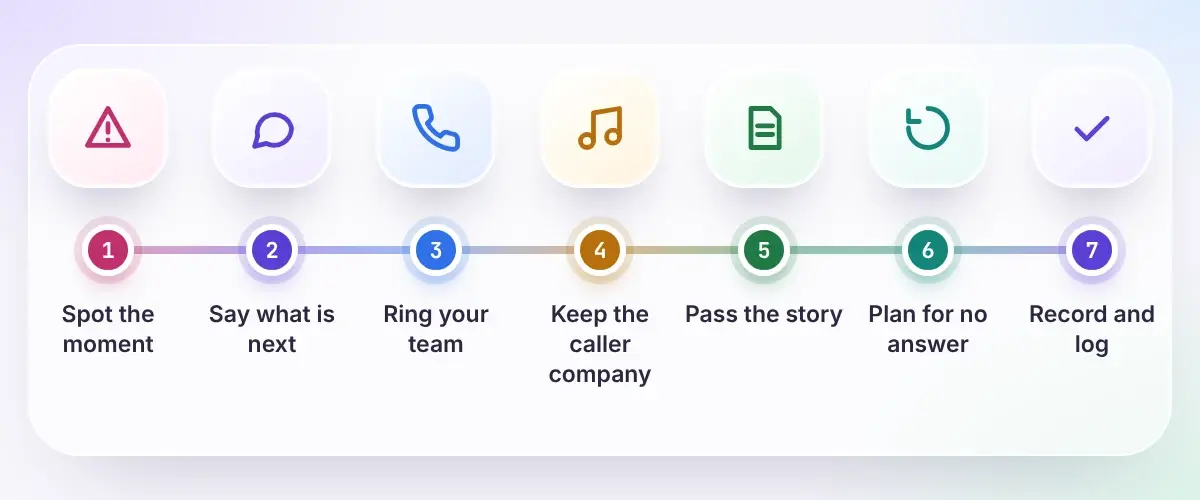
Seven steps:
- Spot the moment. The caller asks for a person, sounds frustrated, or raises a question outside the AI's scope. All of this is configured via plain-language instructions you give the agent.
- Say what is next. The AI tells the caller who is joining and why.
- Ring your team. It dials your number and waits for a pickup.
- Keep the caller company. Hold music plays while it rings.
- Pass the story. Transcript, details and CRM notes go to your team.
- Plan for no answer. Offer a callback that carries the context.
- Record and log. Save the call and update your CRM.
New to AI calling? Start with what an AI voice agent is. Comparing it with keypad menus? Read what IVR is.
How do transfers work in Zoxa?
Short version: Zoxa rings your team's phone and connects the caller when someone picks up. Here is what you control and what to watch for.
Cold transfer in Zoxa: straight to your team
When the AI decides a person should take over, it rings the number you chose. It does not brief that person first, so this is a cold (blind) transfer.
| You choose | How it works |
|---|---|
| When to transfer | Describe it in plain words, like "the caller asks for a person." |
| Who gets the call | Any phone number: front desk, sales line or mobile. |
| What the caller hears first | Nothing, a line you type or a recording you upload. |
| How long it rings | 5 to 120 seconds. The default is 30. |
| Recording | The handover is recorded by default. |
Warm transfer in Zoxa: the story goes with the call
Zoxa passes the call directly to your team while carrying the full context forward. The transcript, key details the AI gathered, and caller notes arrive instantly via Slack, Microsoft Teams, or your CRM before or as you pick up. If nobody is free, it falls back to a callback with the full context intact.
Think of it as a warm transfer in context and a direct connection on the line.
Heads up before you switch it on
- ⚠️ Caller ID. Your team's phone shows the AI's number, not the caller's. Send the caller's details by alert or CRM.
- ⚠️ If nobody answers. It depends on your phone provider. With Twilio, Telnyx or Vonage, the AI stays with the caller. With others, like Plivo, the call ends. Test yours first.
- ⚠️ Once someone picks up, the AI steps out. It does not listen in.
- ⚠️ One handover per call. Calls started from a web browser can't be transferred.
- ⚠️ It is recorded. Tell callers, and check your rules in our TCPA compliance checklist.
Example: how HealthBridge Clinic uses handoff
HealthBridge runs five outpatient clinics. Zoxa passes anything outside its scope to a person: complex medical questions, emergencies and callback requests. Here are the first 90 days.
| Metric | Before | After |
|---|---|---|
| Missed call rate | 28% | 3% |
| Front-desk call volume | 100% | 41% |
| Average call handling time | 4 min 20 sec | 1 min 38 sec |
| After-hours bookings per month | 0 | 210 |
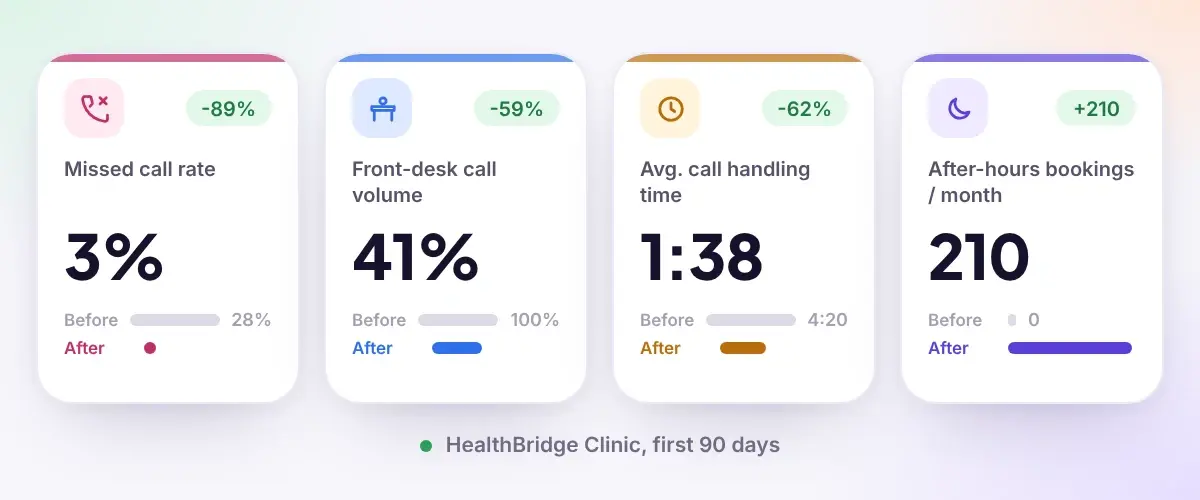
The AI takes the routine calls, so people only get the ones where a human touch matters. Across the first 90 days, 59% of routine calls were resolved end-to-end by the AI, while the remaining 41% were transferred to clinic staff with full context attached. Read the full HealthBridge case study.
FAQ
What is a warm transfer call?
A warm transfer is a handoff where the first person briefs the next one before connecting the caller, so the caller never repeats their story (also called an attended transfer).
What is the difference between a warm transfer and a cold transfer?
A warm transfer comes with a heads-up. A cold transfer does not. A warm transfer suits upset or complex callers, and a cold transfer suits simple routing.
What is the difference between a consult and a conference transfer?
In a consult transfer, the first person talks privately with the next one, then connects the caller. In a conference transfer, all three are on the line together.
Can an AI voice agent do a warm transfer?
It depends on the tool. Some AI agents read out a summary before connecting the caller. In Zoxa, the call goes straight through and the details travel with it as a transcript, CRM notes and alerts.
When should an AI voice agent hand a call to a person?
When the caller asks for one, sounds frustrated, raises something sensitive or complex, or is a hot lead ready to book. Those calls deserve a warm transfer.
What happens if nobody answers the transferred call?
It depends on your phone provider. In Zoxa, the AI can fall back to a callback with context, or stay with the caller. Test yours before you go live.
Meet Zoxa: the voice that never makes callers start over
Remember the caller from the start? She explained everything to a bot, got passed along, and a stranger asked, "So, how can I help you?"
Now picture the same call with Zoxa. It picks up when your team can't, including after hours, and it speaks her language. It books, answers the routine question or qualifies the lead. When she needs a person, it tells her who is joining and why, then rings your team with the story attached. Your teammate opens with, "Hi Maria, I can see the double charge. Let me fix that now."
That is what Zoxa is built for:
- Callers feel heard. It speaks 100+ languages, including Hindi, Punjabi and Hinglish.
- Your team gets time back. At HealthBridge, front-desk call volume fell to 41% and missed calls dropped from 28% to 3%.
- Your brand stays your own. You write the line the caller hears and decide when a person steps in.
- Your CRM stays up to date. Zoxa writes the contact and its notes into your CRM as it goes.
Zoxa works alongside your team. It takes the routine calls, so your people can focus on the ones that need a human.
Hear a Zoxa handover for yourself
Try the live demo and hear a call move from Zoxa to a person, story attached.
Book a Zoxa demo | See how HealthBridge did it