How AI Recruiters Screen Hundreds of Candidates by Phone
An AI recruiter is a voice agent that runs the first-round phone screen with every applicant at once, scores each answer against your bar, and hands you a shortlist with notes. You still make every hiring decision — you just stop losing your week to repetitive intro calls.
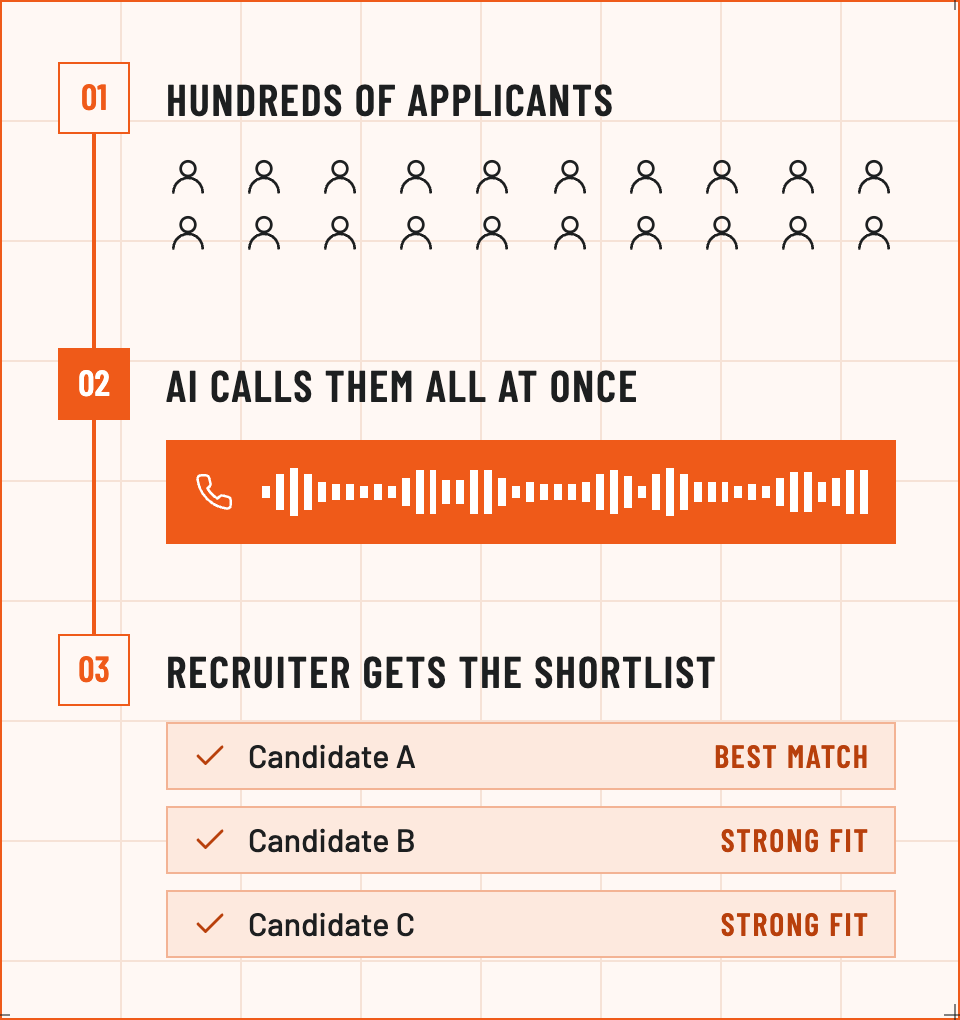
The short answer. An AI recruiter is a voice agent that runs the first-round phone screen with every applicant at once, scores each answer against your bar, and hands you a shortlist with notes. You still make every hiring decision. You just stop losing your week to repetitive intro calls.
Who it's for: recruiters, talent teams, and staffing agencies buried in first-round calls for high-volume roles.
Post one job for a popular role and the applications pile up fast. Sorting resumes is quick. The slow part is the first phone call: confirming the basics, checking availability and salary, and finding out whether the person on paper is a real fit.
Do that for a few dozen applicants and your week is gone. Do it for hundreds and half of them never get called at all, so good candidates go cold while you work through the list. This is the exact job an AI recruiter takes off your plate: it runs the first-round phone screen with every applicant, in parallel, in the candidate's own language, and hands you a shortlist with notes and scores.
Key numbers
- 3,000+ applications screened for one role
- 200+ screens running at the same time
- 25,000+ calls handled across use cases
- 100+ languages supported
What is an AI recruiter?
An AI recruiter is a voice AI agent that handles the phone stage of hiring on its own. It calls applicants (or answers when they call in), asks your screening questions in a natural conversation, understands the answers in real speech, scores each candidate against the bar you set, and routes qualified people to a human. It is sometimes called automated candidate screening, an AI recruiting assistant, or an AI phone screener. The job is the same: replace the repetitive first call, not the recruiter.
It is not a resume filter and it is not an "AI interview" in the sense of a final decision. It handles the top-of-funnel phone screen so your team spends its time on the shortlist. On Zoxa the agent replies in under 1,500 milliseconds and supports 100+ languages, so the call feels like a conversation rather than a form.
Why phone screening is the real bottleneck
Most hiring tools speed up sourcing and resume sorting. That is not where recruiters lose time. The loss is in the first call. Say a role pulls 500 applicants and 300 are worth a 10-minute screening call. That is 50 hours of recruiter time for one role, before a single real interview. Miss that window and candidates accept other offers while they wait.
An AI recruiter removes the trade-off. It does not have 50 hours; it has as many parallel lines as you need. It calls every one of those 300 applicants the same day and gives you a ranked shortlist by morning.
How one list becomes a shortlist
- 300+ applicants, one list. Everyone who applied goes into the queue.
- Screened in parallel. The AI recruiter calls every applicant at once, in their own language.
- Scored on the spot. Each answer is checked against your bar and tagged pass, maybe, or no.
- Ranked shortlist to a human. Only qualified candidates reach a recruiter, each with a full transcript.
Manual phone screening vs an AI recruiter
| What you compare | Manual phone screening | AI recruiter (Zoxa) |
|---|---|---|
| Calls at once | One at a time | Hundreds in parallel |
| Screening 300 applicants | ~50 recruiter hours | Same day, zero recruiter hours |
| Availability | Business hours | 24/7, answers on the first ring |
| Languages | Limited by staff | 100+ |
| Scoring & notes | Manual, inconsistent | Auto-scored, synced to your ATS |
| Recruiter's time goes to | Every intro call | Only the qualified shortlist |
How an AI recruiter screens hundreds by phone
The setup is simple, and it follows the same pattern whether you screen 50 candidates or 5,000.
- You define the screen. List the must-have questions: availability, notice period, location or work authorization, salary range, and two or three role-specific checks. Set the pass bar for each.
- It calls (or answers) every candidate. Inbound, applicants call a number and the agent picks up on the first ring. Outbound, the agent calls your list, retries no-answers, and works through all of them in parallel. See the voice-agent use cases.
- It runs a real conversation. It asks your questions, listens to natural answers, and follows up when something is unclear, in the candidate's own language, instead of forcing a phone menu.
- It scores and shortlists. Each answer is checked against your bar. The agent tags each candidate pass, maybe, or no, with the transcript attached, and syncs the result to your ATS or CRM.
- It hands qualified candidates to a human. Anyone who clears the screen is routed to a recruiter with the full transcript.
What it asks, and where it stops
Keep the AI recruiter to the screen, not the hiring call. It is good at:
- Confirming availability, notice period, location, and work authorization
- Checking salary expectations against the band
- Asking two or three role-specific qualifiers
- Answering the candidate's own questions about the role, pay, and next steps
- Booking the human interview on your calendar for candidates who pass
Where it should stop: final evaluation, culture fit, negotiation, and any judgment call that decides an offer stay with your recruiters. The agent's job is to make sure the people who reach that stage are worth your team's time.
The proof
Zoxa's voice agents have handled 25,000+ calls across use cases. On the hiring side specifically: for a single open role the agent screened 3,000+ applications, with 200+ screening interviews running at the same time, a width no human team can match. A recruitment agency, TScout, uses the agent to screen hundreds of candidates for its clients, so its recruiters only spend time on people who already cleared the basics.
Common mistakes that make AI screening backfire
- Screening for judgment, not facts. Use it for clear, checkable questions. Leave "is this a good fit" to a human.
- No human handover. A candidate who passes should reach a recruiter fast, with context.
- Over-long screens. Keep it to the few questions that gate the next step. A 15-minute robotic quiz loses good people.
- Ignoring the candidate experience. The call should feel respectful and answer their questions too.
- Treating it as the hiring decision. It is the first screen. The offer is always a human call.
Doing it fairly (and legally)
Automated hiring tools face growing regulation, including bias-audit and disclosure rules in some regions, such as New York City's Local Law 144 (bias audits and candidate notice) and the EU AI Act, which classes AI used in hiring as high-risk. Check the rules for the markets you hire in.
Practical guardrails: tell candidates they are speaking with an AI agent, screen on job-relevant facts only, keep a human in the loop for every decision, and keep the transcripts so any result can be reviewed.
Frequently asked questions
What does an AI recruiter do?
It runs the first-round phone screen: it calls or answers candidates, asks your screening questions in a natural conversation, scores the answers against your bar, and passes qualified people to a human recruiter with the transcript.
Can it really screen hundreds of candidates at once?
Yes. Because it uses parallel phone lines rather than one recruiter's calendar, it can run many screens at the same time. On Zoxa, 200+ screening interviews have run simultaneously for a single role.
Is this the same as an AI interview?
No. It handles the top-of-funnel phone screen (facts and basic qualification), not the final interview or the hiring decision, which stay with your team.
Will candidates know they are talking to an AI?
They should. Best practice, and in some places the law, is to disclose that the call is handled by an AI agent. Zoxa agents are human-sounding and answer in under 1,500 milliseconds.
Does it work with our ATS?
It syncs screen results and transcripts to your systems so shortlists land where your team already works.
What languages can it screen in?
Zoxa agents support 100+ languages, so you can screen candidates in the language they are most comfortable with.
Get your first-round calls off your plate
Point one number at a Zoxa agent, load a batch of applicants, and let it run the first screens while your team works the shortlist.
- Start free: dashboard.zoxa.ai
- Book a demo: dashboard.zoxa.ai
- Live demo line: +91 78569 50557