AI Receptionist vs Answering Service: Which One Books More Interviews in 2026?
On a hiring line, an AI receptionist (a virtual recruiting assistant) books more interviews. It answers every candidate on the first ring and puts the interview in the recruiter's calendar during the same call. An answering service takes a message, so the booking waits for a callback.
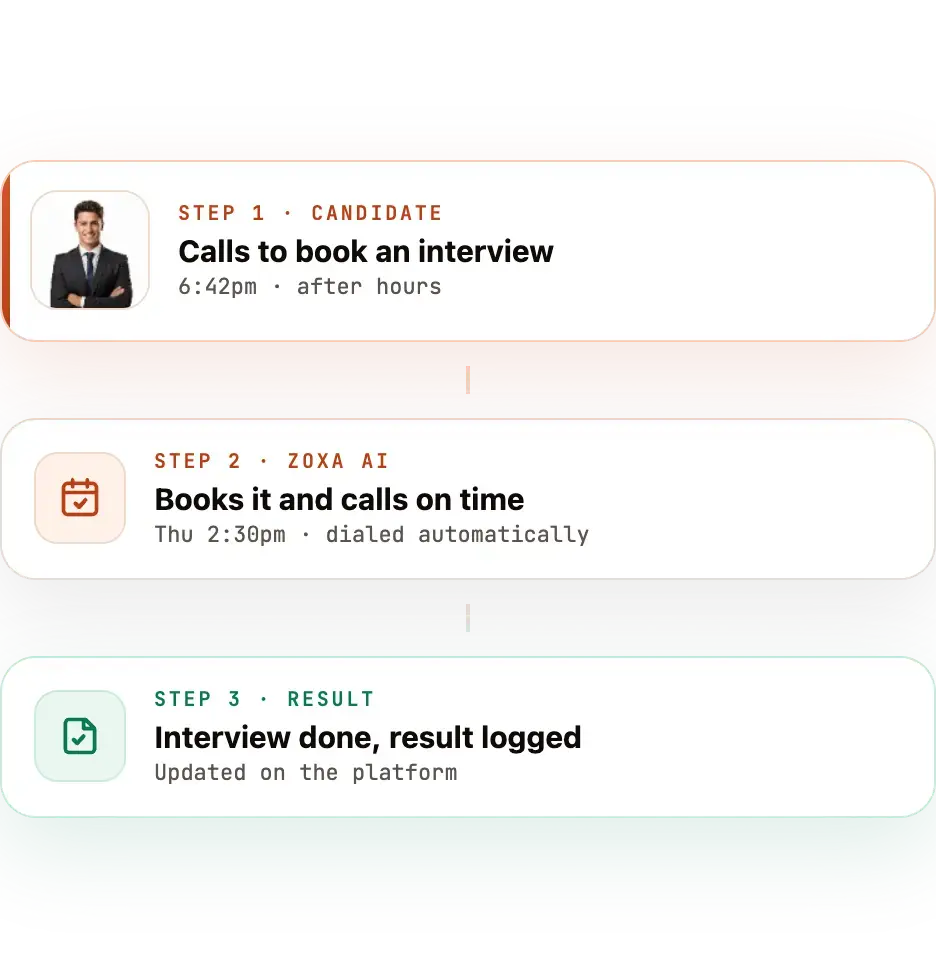
The short answer. On a hiring line, an AI receptionist (a virtual recruiting assistant) books more interviews. It answers every candidate on the first ring and puts the interview in the recruiter's calendar during the same call. An answering service takes a message, so the booking waits for a callback.
- The catch: interviews are not lost when the phone rings. They are lost in the gap between "message taken" and "recruiter called back." One role on Zoxa drew 3,000+ applications, and no message pad survives that.
- Who this is for: HR managers, in-house recruiters, and staffing agencies whose phones light up every time a job goes live.
Post a job on Monday and your phone tells you by Tuesday how it went. Candidates call to check the role is still open, to ask about shifts and pay, and to ask when they can come in. Every one of those callers is ready to talk right now.
A single open role can draw more than 3,000 applications. Even if only a small share of applicants pick up the phone, that is more calls than a two-person HR team can answer between interviews. Calls that go to voicemail don't wait around. Candidates for hourly and high-volume roles usually have several applications open at once, so the first employer to book them usually gets them.
Most HR teams reach for one of two fixes: a live answering service, or an AI receptionist built for hiring. Both make sure someone picks up, but only one books the interview before the call ends. This guide compares the two, works through the math on a real week of calls, and helps you choose.
Want to hear one first? Try a live AI hiring line.
What is a virtual recruiting assistant?
A virtual recruiting assistant is an AI voice agent that answers your hiring line. It speaks with candidates in natural speech, answers questions about the role from your job details, asks a few knockout questions, and books a slot in the recruiter's real calendar. When a caller needs a person, it hands the call over along with the full transcript.
On Zoxa, the agent:
- Replies in under 1.5 seconds, so candidates don't hear dead air
- Detects the caller's language from 100+ languages and replies in it
- Reads live calendars (Google Calendar, Outlook, Calendly, Acuity), books open slots, and sends an SMS or email confirmation
- Logs every call to your CRM (Salesforce, HubSpot, Pipedrive, Zoho) or to your ATS through webhooks and the API
- Answers many calls at the same time, so a spike after a job posting doesn't create a queue
This is a different job from an AI recruiter that runs the screening interview itself. If that is what you need, read how AI recruiters screen hundreds of candidates by phone. This post covers the front door: who picks up when candidates call you.
What does an answering service do for HR teams?
An answering service is a company with live agents who answer your calls under your business name. For an HR team, it usually works like this:
- Your hiring line forwards to the service, either all the time, after hours, or when your team doesn't pick up.
- A live agent greets the candidate using your script.
- The agent takes the candidate's name, number, the role, and a short message, and answers simple FAQs if they are in the script.
- You get the message by email, text, or a portal. A recruiter then calls the candidate back.
Some services sell appointment setting as an add-on. Most bill per minute or per call.
The real strength is human judgement. A good agent can calm a nervous caller, handle an unusual question, and use discretion when a call turns sensitive.
AI receptionist vs answering service: side by side
| Factor | Answering service | AI receptionist (Zoxa) |
|---|---|---|
| Who answers | A live agent from a shared pool | An AI voice agent, with handover to a recruiter |
| Hours | Set by plan; 24/7 often costs more | 24/7 |
| Spike after a job posting | Limited by how many agents are free | Answers calls in parallel |
| Speed to answer | Depends on the queue | First ring, replies in under 1.5 seconds |
| Questions about the role | Only what is in the script | Answers from your job details; escalates what it can't answer |
| Knockout questions | Rarely | Yes: shift availability, location, work authorization, licenses |
| Interview booking | Message for a callback, or a paid add-on | Booked into the recruiter's live calendar during the call |
| Languages | Usually English, sometimes Spanish | 100+, detected automatically |
| What you get after the call | A message summary | Full transcript plus structured answers in your CRM or ATS |
| Billing | Per minute or per call | Plan or usage-based |
Which one books more interviews? The math on one week of calls
Every hiring line runs through the same funnel:
Interviews booked = qualified callers × answer rate × callback reach rate × booking rate
An answering service runs every step of that funnel. An AI receptionist drops the callback step, because the booking happens while the candidate is still on the line.
Here is a worked example. The numbers are illustrative, so replace them with your own. Say 300 candidates call in the week after a job goes live, and 210 of them are qualified to interview.
| Step | Answering service | AI receptionist | Your numbers |
|---|---|---|---|
| Qualified callers | 210 | 210 | ___ |
| Answered | 95% → 200 | 100% → 210 | ___ |
| Reached on callback | 50% → 100 | Not needed | ___ |
| Booked an interview | 80% → 80 | 70% on the call → 147 | ___ |
The callback step decides the result. If your recruiters reliably call back within the hour, the gap narrows. If callbacks slip to the next day, it gets wider, because by then many candidates have booked somewhere else.
We have seen the same effect outside hiring. At HealthBridge, a group of five outpatient clinics, booking during a live call converted at 34%, compared with 8% for SMS reminders asking people to book themselves. See the HealthBridge results.
Compare cost per booked interview, not cost per minute. A cheaper minute does not help you if half the messages never turn into interviews.
When an answering service is the better fit
- Low call volume. If your hiring line gets a few calls a day, a live agent taking messages is enough.
- Senior or confidential roles. Executive candidates often expect a person from the first hello.
- Your HR line also takes employee calls. Sensitive matters such as complaints, leave, or workplace issues should go to a trained person, not an AI.
- Nobody keeps recruiter calendars up to date. An AI can only book the slots your calendar shows. Fix the calendars first.
When an AI receptionist is the better fit
- High-volume hiring: hourly, retail, warehouse, call center, healthcare support, and seasonal roles
- Calls spike right after you post. Parallel answering means nobody waits in a queue.
- Candidates call outside office hours. Shift workers often call at night or on weekends.
- Your applicant pool speaks several languages. The agent detects each caller's language and replies in it.
- You are a staffing agency running dozens of open roles, where every missed call is a lost placement.
The hybrid setup: AI first, recruiters when it matters
Most HR teams don't have to pick just one. This setup works for most of them:
- The AI answers every call. It handles FAQs about pay, shifts, location, and next steps.
- It asks 3 to 5 knockout questions. Only ask what the role actually requires.
- It books qualified candidates into the recruiter's calendar and sends a confirmation.
- It hands over to a recruiter when a candidate asks for a person, the role is senior, the topic is sensitive, or the caller's tone drops. The recruiter gets the transcript, so the candidate never has to repeat themselves.
- Optional: an on-call recruiter or an answering service picks up handovers after hours.
Write the agent's script around real candidate questions, not a job ad.
See how Zoxa voice agents handle handover and booking.
The proof: what happens when candidates reach you instantly
- High-volume hiring: one open role, 3,000+ applications, with 200+ AI-led interviews running at the same time. No human team can phone-screen at that width.
- TScout (recruitment agency): uses the agent to screen hundreds of candidates for its clients, so recruiters only spend time on people who already cleared the basics.
- HealthBridge (clinics, same mechanism): booking on a live call converted 34% vs 8% for SMS reminders. Candidates behave the same way: when the booking happens while they are on the phone, it actually happens.
Keep it fair and legal
This is general information, not legal advice. Check the rules where you hire.
- Say it is AI. Tell candidates at the start of the call that they are speaking with an AI assistant, and give them a way to reach a person. Some states may require this.
- Knockout questions can count as an automated hiring tool. In New York City, Local Law 144 requires a bias audit within the past year and notice to candidates at least 10 business days before an automated employment decision tool is used (Perkins Coie).
- Only ask job-related questions. Never ask about age, religion, disability, pregnancy, or family plans.
- Get consent before AI calls candidates back. The FCC ruled in 2024 that AI-generated voices count as "artificial" voices under the TCPA. Inbound answering is lower risk, but any outbound callback needs consent. See our TCPA compliance checklist.
Common mistakes when choosing
- Comparing price per minute instead of cost per booked interview. The cheaper minute often costs more per hire.
- Letting AI book into stale calendars. Double-booked interviews hurt candidate experience more than a missed call does.
- Too many phone knockout questions. More than five and candidates hang up. Save the depth for the interview.
- No human escape hatch. Every candidate should be able to reach a person.
- One script for every role. A forklift driver and a staff nurse ask different questions.
- No baseline. Measure answer rate, time to first contact, and interview show rate before you switch, so you can prove the change worked.
Frequently asked questions
What is a virtual recruiting assistant?
A virtual recruiting assistant is an AI voice agent that answers a company's hiring line. It answers candidate questions, asks short knockout questions, and books interviews into a recruiter's calendar. When a candidate needs a person, it hands the call to a recruiter.
Can an AI receptionist schedule interviews automatically?
Yes. A voice agent connected to Google Calendar, Outlook, Calendly, or Acuity can offer open slots during the call, book the one the candidate picks, and send an SMS or email confirmation. It can only offer slots the recruiter's calendar actually shows.
Is an AI receptionist cheaper than an answering service for recruiting?
It depends on volume, so compare cost per booked interview rather than cost per minute. Answering services bill per minute or per call and still need a recruiter to call each candidate back. An AI receptionist books during the first call, which removes that callback labor.
Will candidates know they are talking to an AI?
They should. Best practice is to say so at the start of the call and offer a way to reach a person. Clear disclosure also builds trust with candidates.
Is it legal to use AI to answer candidate calls?
Answering inbound calls with AI is generally allowed, but local rules apply. In New York City, an AI that screens candidates out may need a bias audit and advance notice under Local Law 144. AI outbound calls to candidates need prior consent under the TCPA.
Can an AI receptionist and an answering service work together?
Yes. A common setup is AI-first: the AI answers and books every routine call, and a recruiter or answering service takes handovers for senior roles, sensitive topics, or callers who ask for a person.
Stop losing candidates to voicemail
An answering service makes sure someone picks up. An AI receptionist makes sure the interview gets booked. For high-volume hiring, that difference shows up as more interviews, faster time to first contact, and fewer candidates lost to the employer who called back first. For low-volume or senior hiring, a live service or a hybrid setup is still a good fit.
Start free and set up your hiring line in one afternoon, or call the live demo at +91 78569 50557.